13
Issue 13 · Summer
The men who count the puffins
Opening the demo
Reportage · Shetland
It carries the post, the shopping and anyone who needs a hospital appointment. When the weather turns, the island keeps its own counsel for a fortnight.
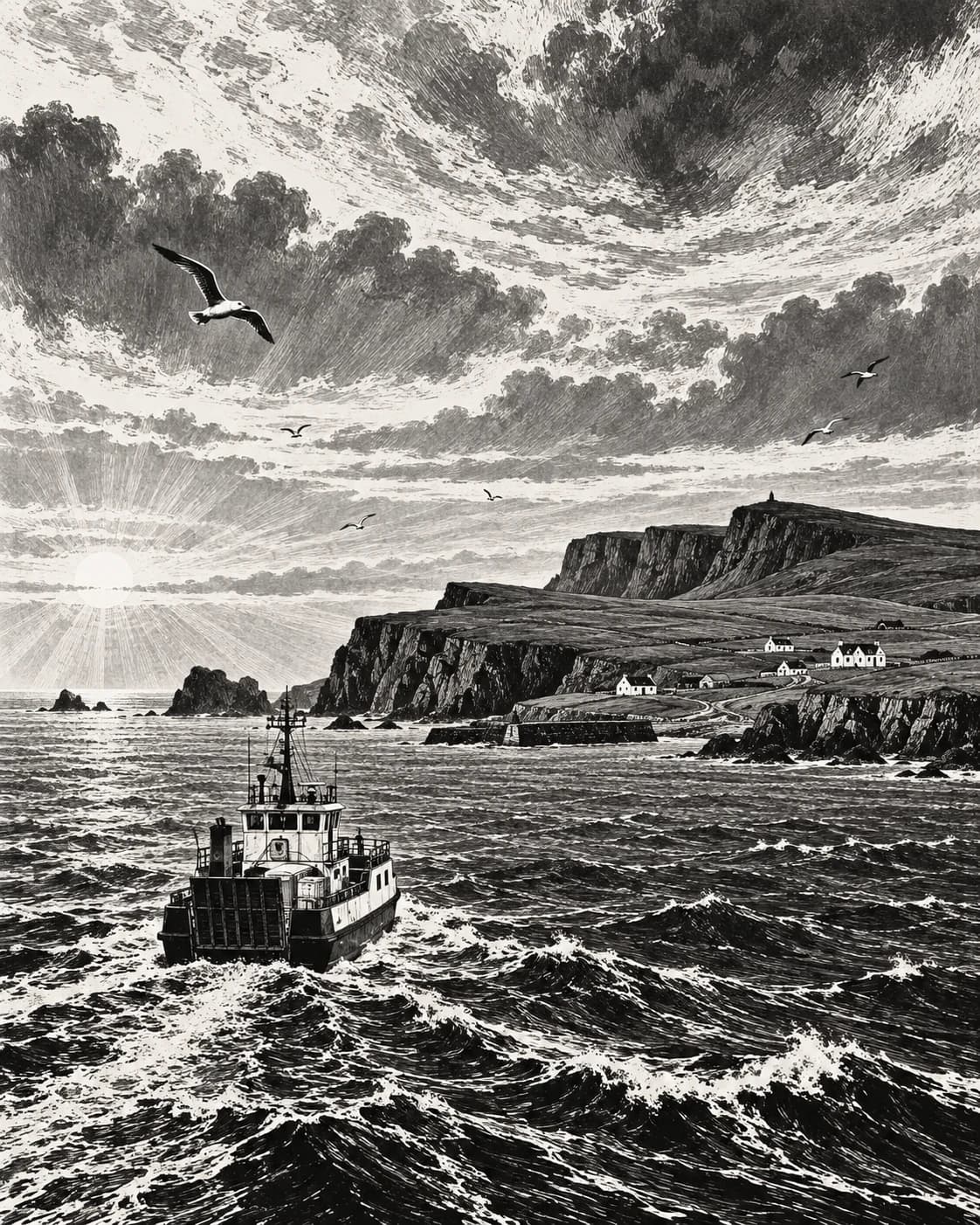
The Good Shepherd leaves at seven, and by half past the mainland is a rumour behind us. There are nine passengers, four crates of milk and a washing machine lashed to the deck with the confidence of a crew who have done this every week for years.
For most of the year the crossing takes two and a half hours. In February it takes as long as it takes, and sometimes it does not happen at all, which is a sentence the islanders say the way other people mention rain.
“You do not move here for the view. You move here and then the view is what you have.”
The washing machine belongs to a family who ordered it in March. It arrived on the mainland in April. It is arriving on the island today, and nobody involved considers this remarkable.
Jenny, who has run the shop for nineteen years, orders in six-week cycles and keeps a mental note of who takes which brand of tea. When the boat misses a fortnight, the shelves do not empty so much as narrow: the tinned goods hold, the fresh goes, and everyone quietly reverts to what the island grew before the ferry existed.
The school has four pupils. The teacher arrived for one term in 2019 and has not left. She describes the job as the only one she has had where the curriculum is genuinely negotiable, because a bird count that happens once a year outranks a Tuesday timetable.
By four o’clock the light is going and the crew are turning the boat around. The washing machine is on a trailer behind a quad bike, moving up the hill at walking pace, followed by two children and a dog. It has taken eleven weeks to travel four hundred miles, and the last half mile is the part everyone will remember.
1. Population figures from the 2022 census. 2. The Good Shepherd IV entered service in 1986 and remains the island’s only scheduled link. 3. Crossing times supplied by the crew, who round generously in both directions.
Three days on a boat that runs twice a week in summer and less than that in winter, with the twelve people whose post, groceries and hospital appointments depend on it.
Forty years after the closure, the building is a climbing centre and the pension scheme is still being argued about in the county court.
The library everyone wanted demolished is now listed. A look at what changed, and whether it was the building or us.
Eleven years of minutes, reproduced in full, on the subject of one shed.
Issue 13 · Summer
The men who count the puffins
Issue 12 · Spring
What the tide takes back
Issue 11 · Winter
A year inside the last pit village
Issue 10 · Autumn
Notes from a closing library
Back issues £14 while stocks last. Issues 1 to 6 are out of print and will stay that way; we would rather reprint nothing than reprint badly.
Your piece on the closing library described the reading room as “a civic apology in brick”. I worked in that building for eleven years and have never read a better sentence about it. My colleagues disagree, which I take as confirmation.
M. Delaney · Coventry
I subscribe for the typesetting and stay for the arguments. Please do not put the magazine on a screen. There is nothing wrong with screens, but there is nothing right about this magazine on one either.
H. Iqbal · Glasgow
There is no digital-only tier because the typesetting is half the point, and no advertising because we tried it once and hated the magazine it made. Nine thousand subscribers pay for the whole thing, which is the arrangement we want.
£42
Four issues, posted flat in board-backed envelopes. UK only at this price; Europe £58, rest of world £71, both at cost. Cancel after any issue and we refund the remainder without asking why.
Fictional stockist list on a concept site.